‘Radical abundance is something you won’t access under capitalism’
A new book, Radical Abundance: How to Win a Green Democratic Future, argues that we are missing some of the tools to achieve a green and just transition. It aims to be a practical guide for popular movements to regain their agency. One of the co-authors, Kai Heron, tells us how abundance can be achieved through public–commons partnerships, council farms and the battle for Seven Sisters Market in London
In your new book Radical Abundance, you and your co-authors, Bertie Russell and Keir Milburn, frame radical abundance in opposition to what you call ‘bullshit abundance’, a term you derive from David Graeber’s ‘bullshit jobs’. What does radical abundance look like, and how is it different from the forms of abundance we currently have?
My co-authors and I introduce two ideas – ‘bullshit abundance’ and ‘artificial scarcity’ – to critique capitalism in a way that is intuitive. Bullshit abundance challenges the idea that capitalism creates loads of wonderful things for us, and that it should be maintained because it delivers wealth and abundance for all. In fact, since 1970 this has been happening less and less. But capitalism does create a certain kind of abundance. If you don’t just think about the commodities that capitalism produces, but you think about the broader ecological consequences, you get things like microplastics that course through our bloodstreams, or carbon emissions, or traffic. These things are not contingent but necessary parts of how capitalism functions because it’s organised by profits not social and ecological needs. Then there’s artificial scarcity, a term we borrow from Jason Hickel and from Kohei Saito. In the book, we say that capitalism creates a bullshit abundance of profits for some by imposing scarcity on the many. And we think about that as a scarcity of the things we need to live and flourish, such as free time (the most important thing, I think) affordable energy, water, biodiverse landscapes and environments.
You frame radical abundance quite neatly in the book as more of what we need and less of what we don’t.
Exactly. What we mean by radical abundance is something that you won’t really access under capitalism. You might get glimmers of radical abundance, moments of, say, collectivity with one another, or moments where the profit motive is lessened. But we basically take radical abundance from the socialist tradition to say that it happens when the so-called realm of necessity is eased, and we get the expansion of our realm of freedom – so, the capacity to do what we want to do. The additional twist is that radical abundance comes from the act of creation as a result of that freedom. Once you’ve got the free time collectively, you can determine to do whatever you like. That’s what radical abundance looks like: it is whatever we choose it to be, once we have the time and capacity to act differently.
The word ‘abundance’ is very much in the air, and there are many different versions of it: from the neoliberal, market-led forms to the more radical forms you’re interested in. Why do you think abundance is suddenly such a current and contested word? And what’s your view of some of the other definitions of abundance to yours?
As an environmentalist and a political ecologist, I think it’s an important term. One reason to use it on the left is to counter the idea that communism or socialism leads to scarcity – to a life of standardised, homogenous, boring architecture and design, and lots of queuing for the things that we need. But abundance is a communist notion from the beginning: it’s evident in Marx when he talks about overcoming scarcity to enable abundance and creativity, and it’s obviously there in people like William Morris or Istvan Meseros.
We’re trying to push back against a capitalist ideology that says anything other than capitalism will not deliver abundance, it will just deliver you scarcity and misery. People have tried to do this through ideas like ‘fully automated luxury communism’, which I’m much less sympathetic towards, partly because it doesn’t think about ecology properly. The reason to claim it from an environmental perspective is different. While there are real ecological limits that we cannot cross and still maintain the conditions for human flourishing – such as those studied by the Stockholm Resilience Centre – an overemphasis on these can lead to a politics of scarcity, which then repeats a kind of Malthusian logic. Emphasising abundance says that we still live on a planet that can generate not just sufficiency, but opportunities for a kind of excess creativity, play, enjoyment, if we facilitate and enable that collectively. My go-to example is the strawberry on the front cover of our book. Strawberries self-propagate. Once you plant one, they put out a runner and that creates another strawberry plant, and then that strawberry plant creates another. It’s very easy to get an abundance of strawberries in a small space. Well-managed ecosystems are full of examples of abundance like this.
When it comes to Ezra Klein and Eric Thompson [authors of the 2025 book Abundance], I don’t recognize their notion of abundance as abundance at all. It concerns me that it’s a very eco-modernist logic where Man – and I use ‘Man’ advisedly – is an urban creature and the countryside is rewilded. The book starts with this idea that you open your fridge, and it’s full of vertically farmed food and lab-grown meat. But it’s all still constrained by capitalist artificial scarcity. The whole point of the book is a defence of capitalism. They’re not thinking about abundance as something outside of the realm of necessity – as something to do with freedom, creativity and the collective power and capacity unleashed when we free ourselves from capital. This means it ends up being a rebranding of neoliberal logic. The idea being that we get the NIMBYs out of the way and we can plan these mega projects of public transportation and so on. Even the idea that public transport is abundance – it’s a necessity, not abundance. To reframe necessity as abundance is quite a sleight of hand.
Kai Heron
We were missing some of the tools for how to think about transition.
What is interesting about your book is that it’s not a piece of speculative futuring. It is very practical and grounded in strategies of transitioning to what you call ‘a green democratic future’. Which suggests that you feel we’re missing the tools for the practical work of that transition. Why do you think that is?
Transition is the problem of our times. There’s the transition as US imperial hegemony declines and China rises, or the transition in political sentiments away from the centre towards the far right. And then there’s the so-called green transition, which isn’t happening (we’re adding renewables to fossil fuels, not taking fossil fuels away). And yet on the left, there’s been this kind of odd absence of [practical approaches]. For a while after the 2008 financial crash, Mark Fisher’s idea of capitalist realism reigned – that it was easier to imagine the end of the world than the end of capitalism. And then, around 2015–16, that changed and people started having these almost utopian visions of the future. You can rattle the list off: there’s fully automated luxury communism, half-earth socialism, degrowth, the Green New Deal. But what these didn’t do was dwell in the messy realities and practicalities and contradictions of transition. So in that sense, yes, I think we were missing some of the tools needed to think about transition.
The book looks at a series of case studies which you draw inspiration from. For example, you look at communes in Venezuela, Cooperation Jackson in Mississippi and there’s the Basque community initiative of Hernani in Spain. These are mostly small-scale eco-socialist or communitarian initiatives trialling innovative ideas. Can you outline a couple of key ideas that you think need to be deployed more widely?
Yes. A lot has been written about the movement of squares around Occupy and Gezi Park, and then the tendency towards parties led by Bernie Sanders and Jeremy Corbyn, but there’s another tendency that didn’t get much attention. One is what we call ‘popular protagonism’. Briefly, it’s the idea that you create institutions, spaces, opportunities where the popular classes – broadly defined – can come together and find a collective shared interest and then act to implement their own freedom and emancipation. And it says that we need institutional forms that can expand our capacity to act collectively. And by acting together, we change our consciousness and our mode of engagement. We take that idea from Marta Harnecker, who’s a revolutionary journalist who worked in Kerala in India, Venezuela and elsewhere.
The other idea is ‘contested reproduction’. This is the idea that in a moment of transition, socialist or post-capitalist logics – broadly conceived – will intermingle with capital, capitalist divisions of labour and capitalist profit motives. It becomes this very messy and contradictory space, but transition becomes possible by pushing towards a post-capitalist or socialist alternative. And so, we’re looking for examples where popular protagonism and contested reproduction converge. And it turns out that this happens in a lot of places.
We looked at Venezuela and its communal system, Kerala’s democratic planning, the Basque territory, Berlin and its struggle around tenants’ strikes, and Cooperation Jackson in Mississippi. In each of these areas, we think we see this convergence of popular protagonism and contested reproduction. We wanted to show examples that could be translated into different contexts where people are organising. And so, intentionally, they’re global to show that this can work in most places.
Can you speak more about Cooperation Jackson? When I think about it, I think of a Black community organising itself to grow its own food, produce its own products, get people involved in making and building. These are very practical things, but also educational, economic and community building. What would you say is unique about Cooperation Jackson?
Cooperation Jackson draws on the Black Belt thesis – the idea that since the Southern states of the USA are majority Black, and yet governed by white settlers, then they should be viewed as an oppressed nation fighting for self-determination. This is a rich tradition of thought, with a pre-defined subject of political contestation. We lack this in the UK. Or, more properly, it was taken from us with the defeat of the revolutionary workers’ movement. Cooperation Jackson’s context means it can connect different projects across geographies, making them more than the sum of their parts. For instance, it’s great to have a community garden, but on its own, it’s just a community garden. Once you start building that into a solidarity economy, integrating other features like education and a horizon of liberation, you get this amplification of each struggle. Something similar is happening in Hernani in the Basque territory. Because of the existence of the Basque language, there is a Basque people inhabiting the space occupied by Spain and France, where they organise to build territorial sovereignty. That means interlinking cooperatives, not just having community ownership of one thing, but linking different sectors together to become, again, greater than the sum of their parts. To build popular power and contested reproduction, if you like.
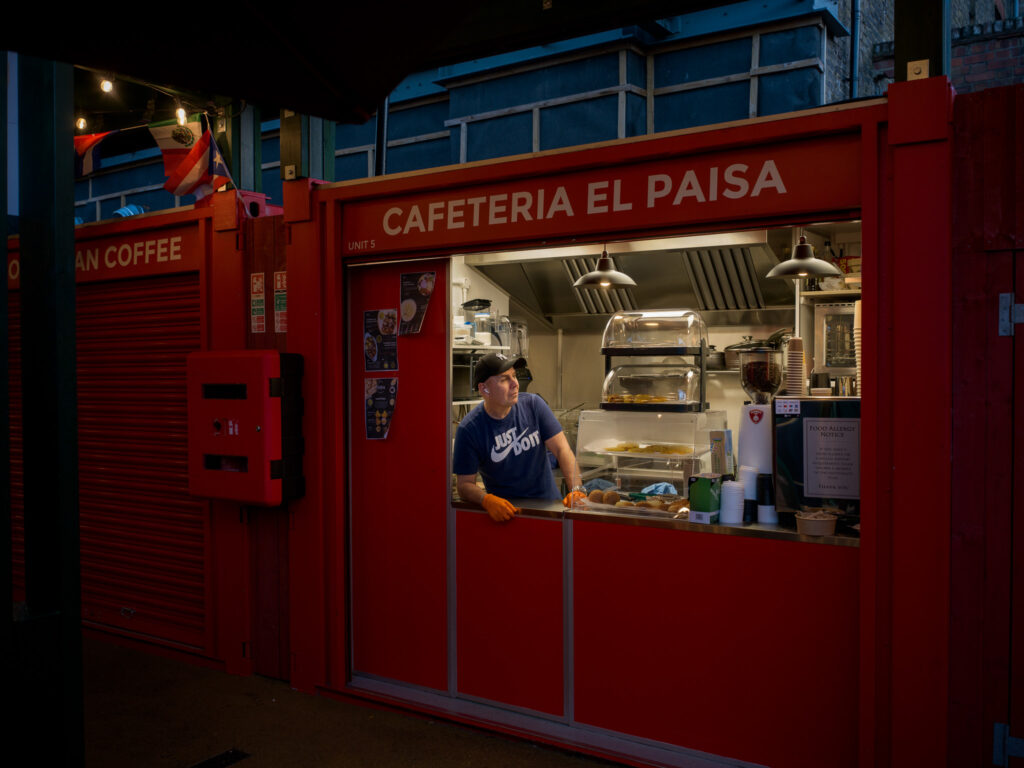
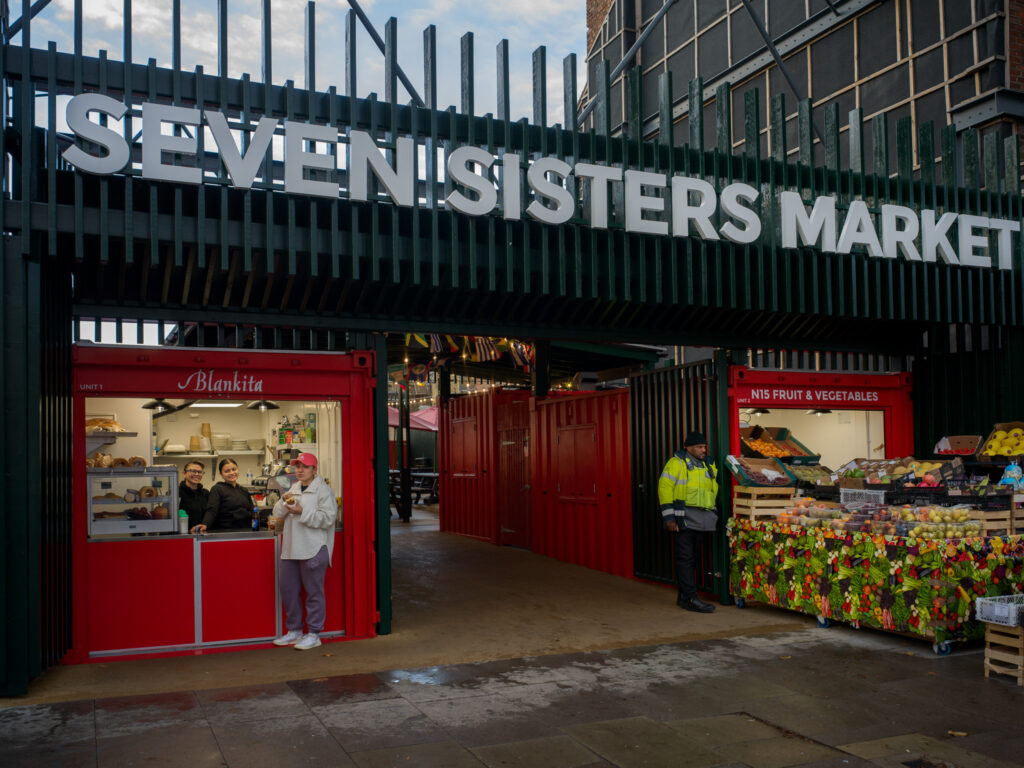
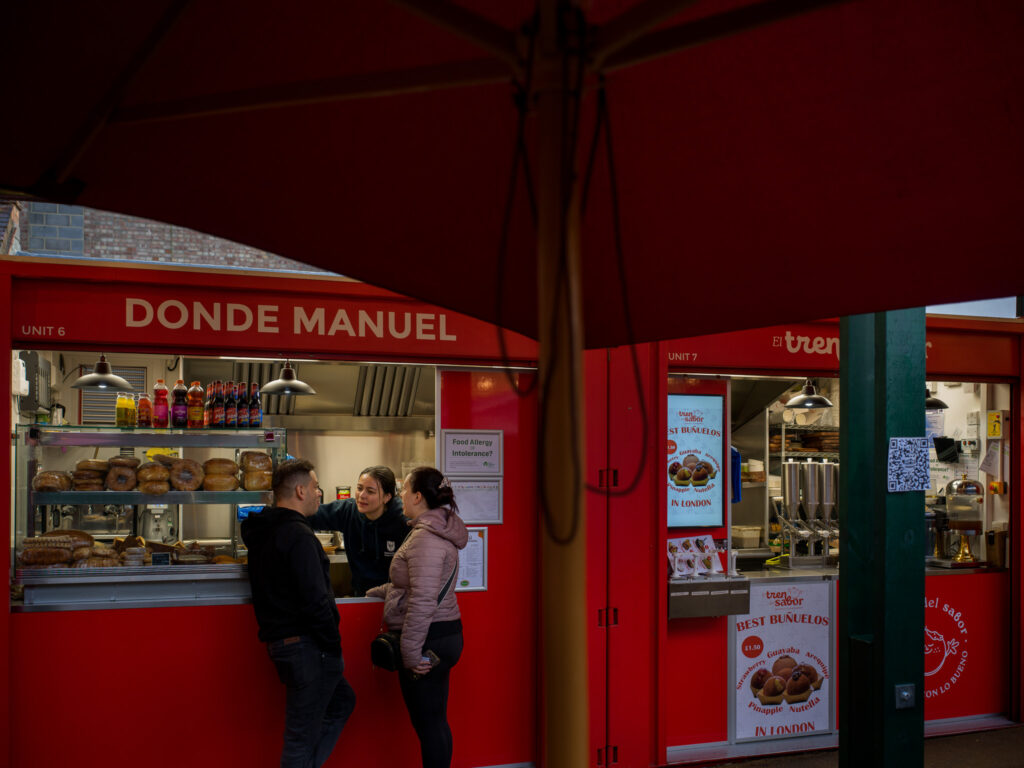
The struggle for Ward’s Corner, sometimes called Latin Village, has been going on for 15 years, and it’s a wonderful example of community defiance against gentrification in one of the most expensive cities in the world. Through our relationship with an architecture practice called Unit 38, Abundance helped Ward’s Corner develop a community plan. At the same time, Bertie and Keir and I were beginning to think about public–common partnerships. Unit 38 said, ‘We’ve got a perfect case where this could work.’
Kai Heron
Instead of giving money to the private sector, why not give money to workers and communities.
The public–common partnership (PCP) is really the key tool in the book. We’re all familiar with the public–private partnership, which is a cornerstone of neoliberal development. Tell us what a public–common partnership is and why it’s a radical alternative.
Yes, we are all familiar with public–private partnerships but let me just briefly run through what they do. They try to de-risk sectors that we need, where the state believes that private capital and expertise is required, and so the state gives public money to private enterprises to run them. There’s lots of evidence that this doesn’t work – Carillion is the most well-known case – and it’s not cost effective for the state. But what it does show is that the state is willing to use public money to support projects. And if the state’s making a political choice like that, our wager with public–common partnership is that it could go the other way. Instead of giving money to the private sector, why not give money to workers and communities who themselves are already using these assets, know how they work, know the territories, have the networks and so on, to allow them to provide their own services, assets and resources. That’s one part of what a public–common partnership is. It gives communities and workers control over the assets and resources that they need. In some ways this already happens: community land trusts would be a good example. But what is novel about a public–common partnership is the self-expansion of the commons, as opposed to the self-expansion of capital. So, a PCP does have to generate a surplus to be a PCP – this is quite important – but that surplus must support another PCP somewhere else. And then that one, hopefully, is successful, and can provide some revenue and know-how towards another PCP. And in this way, you keep building up these spaces of popular protagonism and contested reproduction.
Like your strawberries… You describe this as a piece of ‘institutional design’. What does a PCP look like in practice?
Using Ward’s Corner as an example, it takes the form of a Community Benefit Society (BenCom) [which was established by the Conservative government during its Big Society phase] and enables the community to own that asset or resource. The reason why it’s a public–common partnership is that Ward’s Corner is owned by Transport for London (the Tube line goes straight under the building). We couldn’t have a case here where the public sector gives the building to the community; Transport for London has a vested interest in the space being structurally sound. But that doesn’t mean that it should decide what happens in the building, where the profits go, who runs it day-to-day. What a BenCom allows us to do is give Transport for London certain rights and responsibilities over the maintenance of the building. Then, the surpluses or anything else that happens in the space is the responsibility of the community. With a PCP, the aim is to insulate the commons from the disciplinary forces of state and capital. It’s a case of creating a space where community democratic planning over surpluses and expenditure of surpluses can be protected. In this strict sense, Ward’s Corner is not a PCP yet, but we’re working on it.
It’s an interesting detail that, being Latin American, a lot of this community can draw on a tradition of organising and activism. From the perspective of a market stall holder, you would have a say in how your budget is spent. What else does it give a market stall holder?
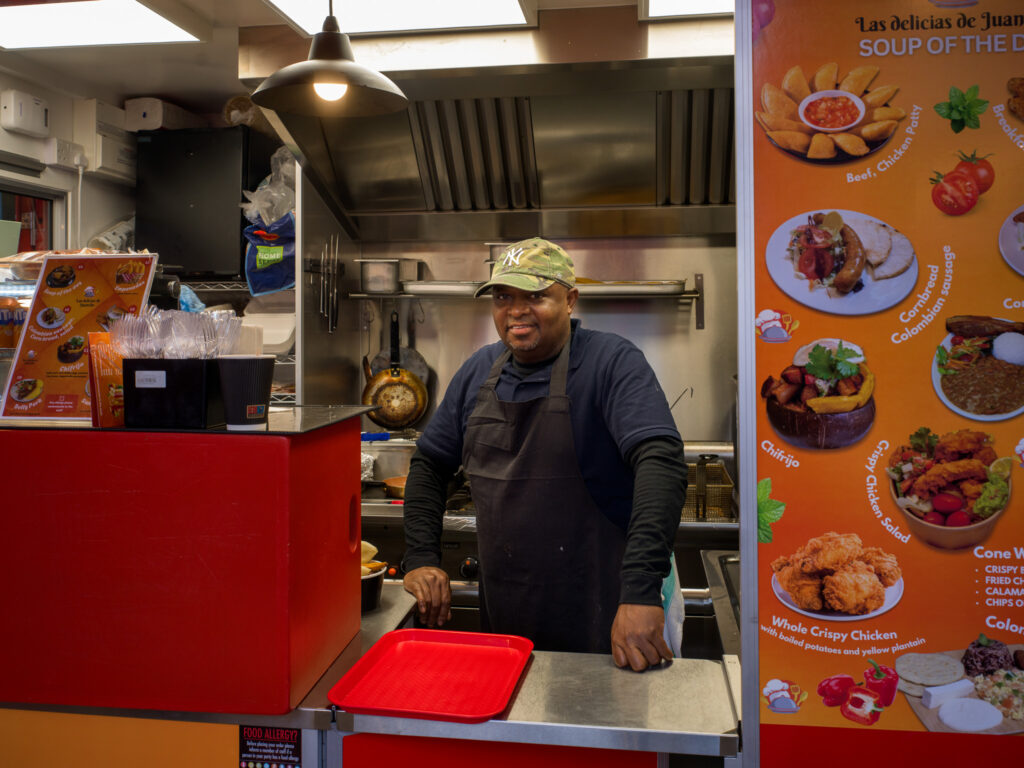
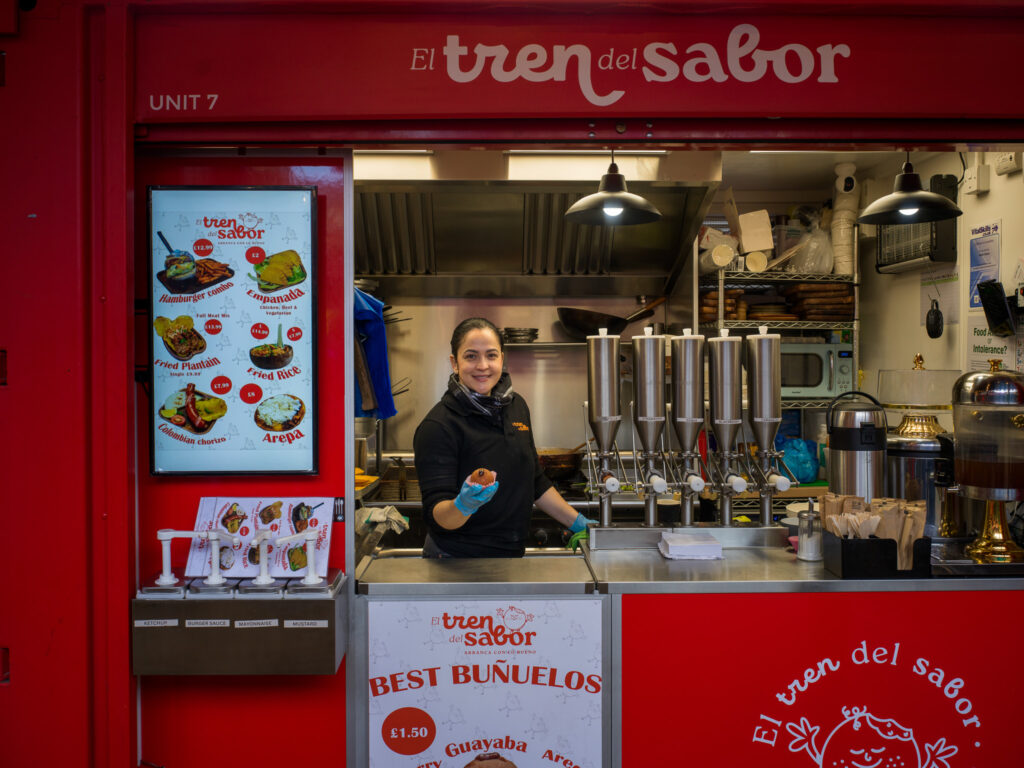
Secure occupation of the building for a start. They also have a say in how the market is run. As workers in the space, they self-govern. And then it also gives connections with a broader community. The stall holders are absolutely critical to a public–common partnership, but they are not the only people who allow the market to exist. The connections go into the wider community, where their children maybe have childcare or where their healthcare needs are provided for. One of the complex things about this is that a stall holder can have a petty bourgeois, individualistic mindset of ‘what’s in it for me?’ But because a public–common partnership collectivises the spending of a surplus, and collectivises community planning, it introduces a collective mind-set among classes that might not otherwise think and act this way.
Since we’re talking about a market, could you link your thinking to the abundance of food? The opportunity you elaborate in the book is the council farm. What is a council farm and how does the concept of abundance apply to food in the UK?
I’m glad you made the connection between the market and the council farm because we are trying to think across sectors. One way to expand the commons in the case of Ward’s Corner would be that market traders could purchase produce, meat and poultry from a commonly owned farm. By doing this, we take more food into democratic control, which is one of our objectives and aims. Because the price of land in the UK is extortionately high, we need to look for creative institutional opportunities to do this. The opportunity we landed on is a pre-existing institutional form in England and Wales called a council farm – or sometimes a county farm – which was created after World War I to enable people returning from war to access publicly owned land that they could farm at an affordable rate. Once they’d gained enough capital from what they produced they became successful farmers in their own right.
In practice it never worked, the main reason being that the margins of profit in food systems are notoriously low. Food, as people like Jason Moore and Raj Patel have pointed out, needs to be cheap, because if it’s cheap, then that makes labour cheap. And if labour is cheap, capital makes more profit. But if food is cheap and margins are low on farms, then a farmer can never move off their farm with enough capital to buy private land. And that’s exactly what happened: people got stuck on these council farms in tenancies and never moved on. Jump forward a bit and we have austerity in the UK. Local authorities are losing their budgets from Westminster and looking for opportunities. How do we provide our essential services when we don’t have the budget? The solution is a fire sale of any asset that they can sell, including council farms, which aren’t working anyway. But it’s short-term thinking, because once they’ve sold the assets to developers, those assets don’t come back.
But rather than selling that land for a short-term capital fix, that land could be used to facilitate a move towards more sustainable, biodiverse food systems. We need to transition away from monocultural food systems, industrialised food systems, towards something more biodiverse – what’s called agroecology. The problem here is that capital will not do this for us – it simply refuses to invest because, in the period when land transitions from a monocultural system to an agroecological one, productivity and therefore profit drop. Plus, agroecology is more labour-intensive, so the wage bill is higher. But the state could step in and say: we absolutely need to prove that agroecological food production can and will work. If they took a risk and gave this land to communities – to land groups like Landworkers’ Alliance or Land in Our Name (LION), a Black-led land justice movement – what we would get is not an immediate surplus, but we would make progress towards our green targets, biodiversity quotas and decarbonisation. And food is put into the hands of communities.
This is a perfect example of how to bring abundance back to a landscape. If you look at any monocultural food system, the whole point is to make it ecologically simplified so that one thing and one thing only grows and thrives – nothing else. Agroecology uses biodiversity to get mutually benefiting growth systems. Yes, we may have pests, but we can use the things that prey on those pests as a natural pesticide. And we can intercrop so that we get nitrogen-fixing legume plants alongside plants that require more nitrogen, and so on.
When you think about depictions of abundance in art history, they are often depictions of food. But is the idea to connect the council farm back to a market like Wards Corner?
That is the goal. If you have a dairy cow, the milk is very cheap. But if you turn that into ice cream, the profits go up. And then if you can sell that ice cream at community events, markets like Ward’s Corner and so on, you can retain these profits within the community and the network, then use that to seed and produce more PCPs.
I’m very aware that what we’re talking about here is generating ‘surpluses’ and using them to invest in the production of new things. That does sound quite capitalist, right? But we’re going back to this idea of contested reproduction – that in these moments of transition, there will not be a clear break where we have organised socialist production. We’re going to have to empower each other to step away from capital for our collective reproduction. And in those moments, capitalist and socialist dynamics will exist side by side.
The book ends with food systems and the food sovereignty movement to prompt thinking across national and international scales like this. Food sovereignty isn’t something that we could have in England alone. It is an international and a global movement. So we want to step away from the idea that the answers are localist initiatives, and show that they can and must be global.
And then a final thing – one thing I’m very interested in with food: If we control our food supply, we can support other movements in exciting and interesting ways. When people go on strike, one of the primary reasons for stopping is because they can no longer provide – they need to pay their bills or buy their food. But if we own our energy companies and food system, we can act in solidarity and provide support. Historically, successful strikes have had this kind of community support. It’s a big thing to end on, but that’s the ambition – that these commoning spaces could provide and support beyond immediate provisioning.