The Abundance Paradox
Africa’s secondhand clothing markets provide millions of consumers with upcycled and customised garments. Unlike Western fast-fashion, this circular model offers a blueprint for achieving more with less. Could the circular economy be the continent’s comparative advantage?
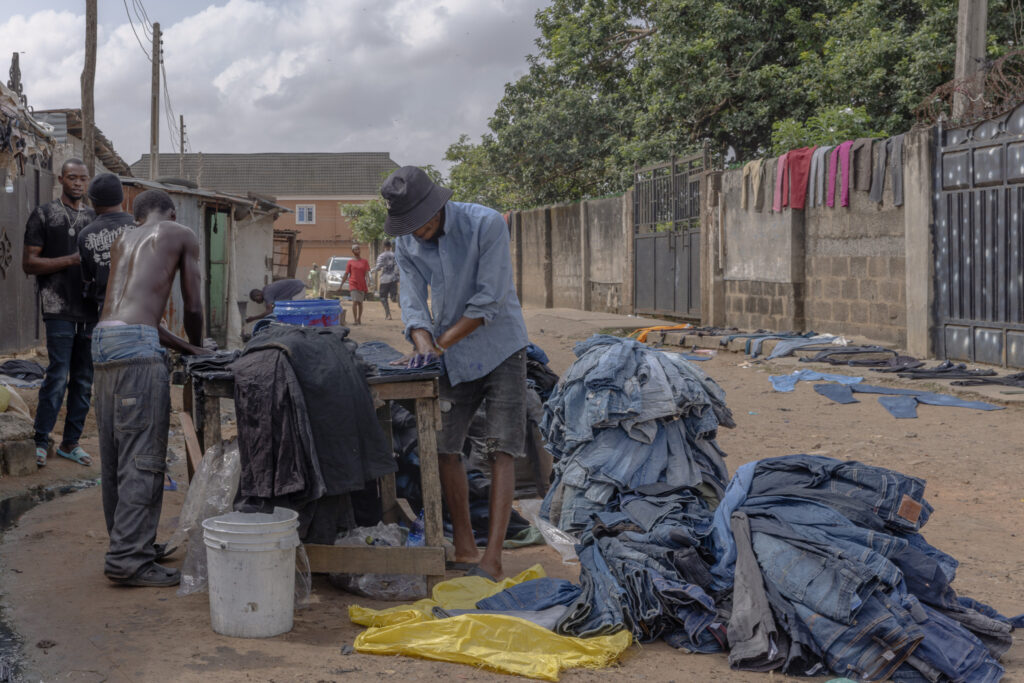
Before the sun even rises, importers at Katangua Market in Abule Egba, Lagos, are already selling second-hand clothing bundles to groups of retailers. Goods arrive as 50–100 kg bales imported mainly from Europe, North America and East Asia. Traders purchase these bundles without knowing their exact contents, a model that creates both risk and potential reward. Once purchased, the bales are sliced open, and items are quickly sorted into categories in preparation for the 8am rush, when crowds of customers arrive in search of affordable, ready-to-wear clothing and shoes. In the alteration section, tailors stand ready to adjust purchases on the spot.
Kantangua is one of numerous second-hand markets that have become fixtures of Africa’s urban economy since the 1990s. Whether dealing in food, household goods or reappropriated clothing, these informal spaces demonstrate that urban systems can function effectively without complete reliance on formal infrastructure. At the same time, they challenge the prevailing narrative that equates progress solely with Western-style retail and planning models. The prosperity created by these models is extremely fragile, especially in Africa, where systems established by imperial and industrial powers have historically diverted development away from the continent’s direct benefit. One might be tempted to see these informal markets as a disadvantaged version of Western ones. However, recognising the legitimacy and intelligence of Africa’s second-hand markets opens up possibilities that blend global flows with local ingenuity. Could it be that this kind of circularity is actually Africa’s comparative advantage in world trade?
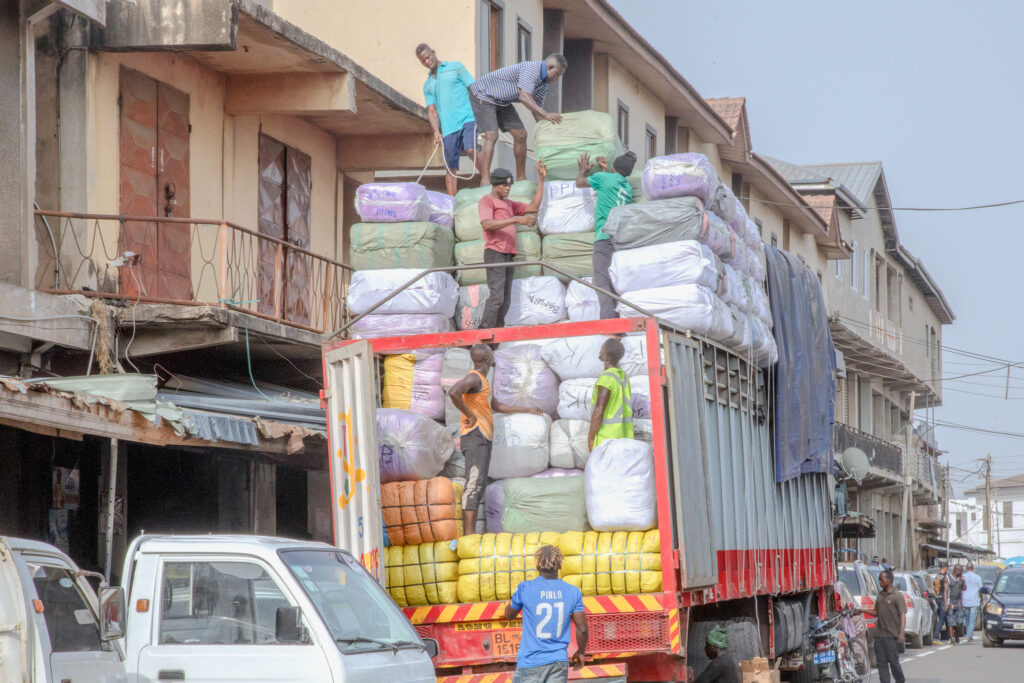
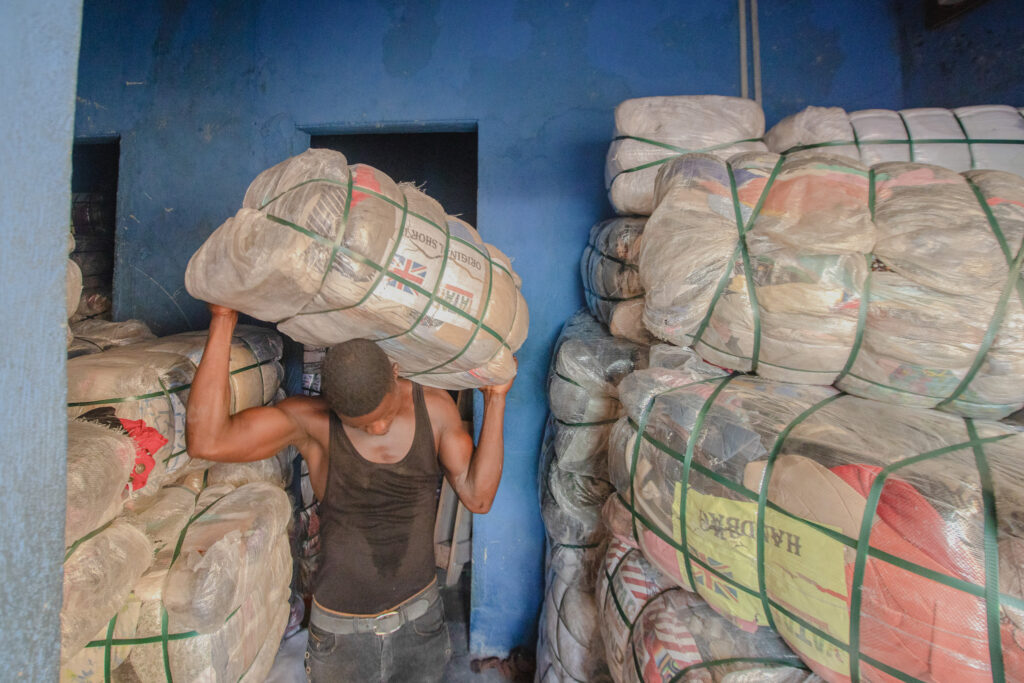
Africa has long paid the price when it comes to the goals of the Global North. Colonialism profoundly shaped the socio-economic development of African cities, defining the composition of the overall urban fabric through housing typologies, industrial infrastructure, religious practices and places of worship. Despite economic and infrastructural gains made during colonial rule and in the immediate post-independence years, the continent paid again for the West’s problems in the late 1970s and early 1980s, when global commodity price crashes precipitated the African debt crisis. In response, the International Monetary Fund (IMF) and World Bank influenced Structural Adjustment Programs across African countries, which reduced subsidies, privatised state enterprises and liberalised trade. Alongside these interventions, states continued to suffer from extractive colonial legacies, weak institutional foundations, political instability, policy missteps and poorly conceived economic strategies. The effect of all of this was the collapse of local industry, including domestic textile manufacturing. Into this gap poured vast quantities of second-hand clothing from Europe and North America. What was initially framed as charitable recycling rapidly formalised into a profitable global trade, for despite the years of austerity and hardship created by the global economic crisis, there was also space for a distinctly African approach to urbanism – one that can be understood not merely as a form of survival, but as an alternative expression of modernity shaped by the dynamics of globalisation.
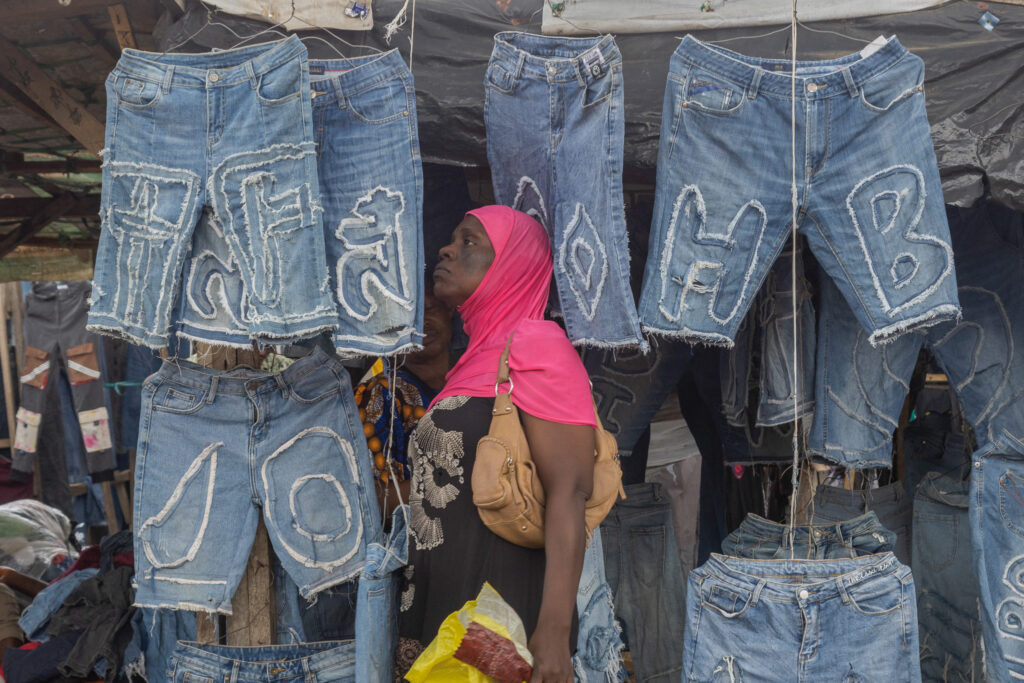
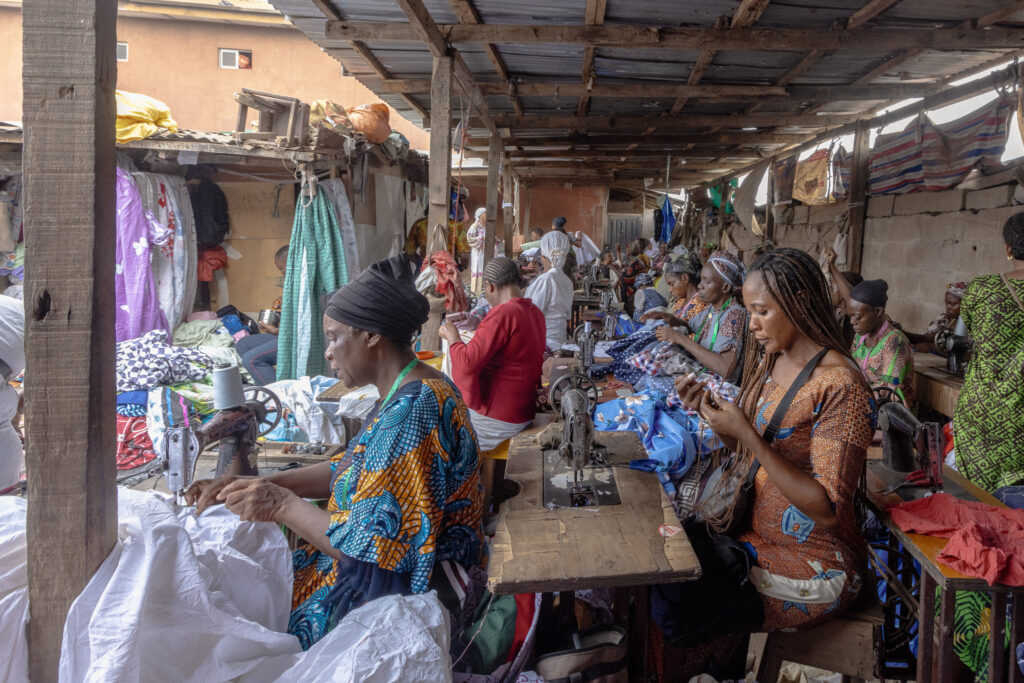
Today, markets such as Kantamanto in Accra, Gikomba in Nairobi and Katangua in Lagos process hundreds of tonnes of imported clothing each week. They provide affordable goods and support thousands of livelihoods, but they still absorb the excesses of Western hyperconsumerism: as much as 40 per cent of imported garments are unsellable and end up as waste. Such a model relies on a structure rooted in colonial extraction economies, reinforcing a cycle that limits African economies to the consumption end of global capitalism. While urban centres across the continent are increasingly integrated into global retail and manufacturing networks, much of the value creation occurs elsewhere, leaving African cities as net importers of both goods and cultural consumption patterns.
An unexpected effect of hyperconsumerism on many African cities has been the creation of a circular economy in which these very excesses are reappropriated through informal markets, pointing to a form of closed-loop capitalism. Traditionally, Western-style retailers have struggled to gain lasting traction in Africa, largely because they are based on economic and spatial assumptions that do not align with the continent’s structural realities. These models rely on high markups, imported goods and fixed-location formats – features that inherently limit their accessibility in markets where the majority of consumers operate with constrained spending power. By contrast, the informal market system of open-air stalls, street vendors and periodic trading hubs remains the dominant and most adaptive retail structure for millions of urban Africans, scaling in pace with urban population growth and economic shifts while evolving into sophisticated hubs for processing second-hand goods. These decentralised networks move astronomical volumes of items with speed and efficiency, relying on community trust systems, cash-based transactions and labour-intensive processes such as sorting, repair and creative repurposing. In doing so, second-hand markets function as an unrecognised form of circular capitalism, extending the lifecycle of garments that formal retail systems would otherwise discard.
The trade has evolved into a multi-billion-dollar transnational system, with Africa accounting for 70 per cent of all charitable clothes donations (Oxfam) and 34–40 per cent of the second-hand clothes industries supplies (UN Comtrade and Greenpeace Africa, 2023). Today, in some African countries, second-hand clothing accounts for up to 80 per cent of apparel sales. While often criticised for undermining local textile industries and contributing to environmental waste, the sector also demonstrates how informal economies create value from abundance generated elsewhere, extending product life cycles, redistributing goods across class divides and in some cases fostering forms of a circular economy through necessity rather than design.
Across the African continent, informal markets are more than economic spaces; they are living systems of urban intelligence rooted in cultural continuity and adaptive efficiency. Rather than relying on the prescriptive frameworks of formal urban planning, they operate through decentralised, bottom-up processes that predate colonialism and are closely linked to the periodic market traditions of precolonial Africa. The result is a spatially flexible, economically inclusive model capable of integrating both local production and global supply flows. This very resilience also explains why the sector has not been absorbed into formal channels: the unpredictability of supply, lack of standardised quality and tension with import regulations clash with formal retail models, while brand-conscious Western fashion industries resist legitimising a trade that could undercut primary markets. The result is a paradox – an industry that sustains millions and operates at a continental scale, yet remains excluded from official economic strategies, limiting its potential to evolve into a more sustainable, regulated driver of African urban economies.
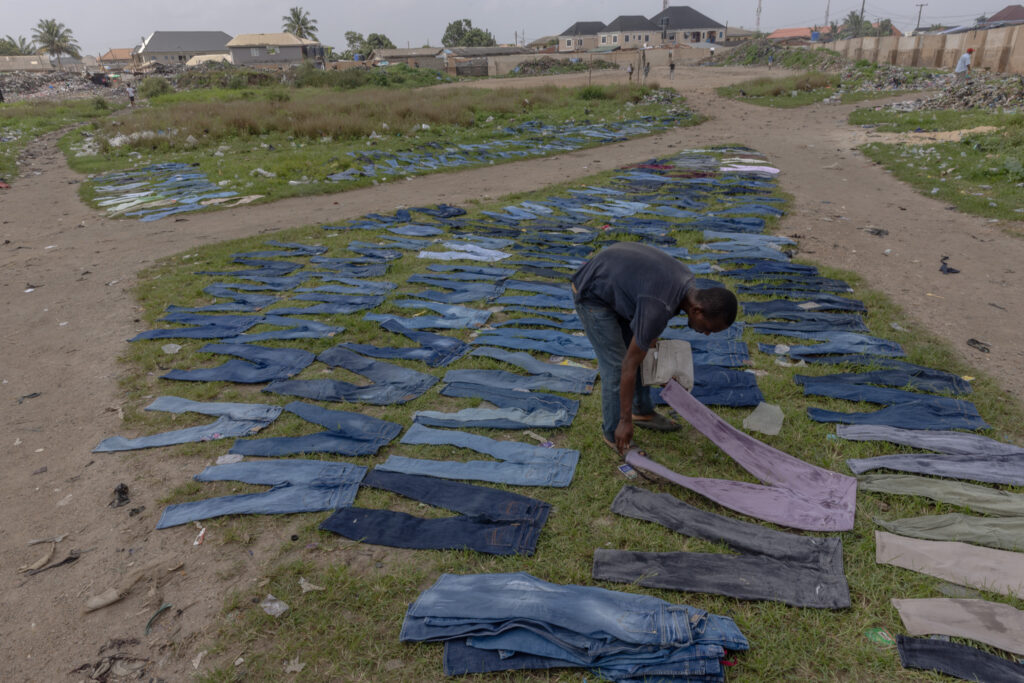
Katangua is one of West Africa’s largest second-hand clothing markets, spanning over 20 hectares and operating three days a week, drawing traders from across Nigeria and neighbouring countries. However, 30–40 per cent of the garments are unsellable due to poor quality or damage. But rather than being thrown away, these goods undergo complete transformation: sorting, washing, alterations, customisation and sales. In many cases, unsellable items find new uses beyond clothing, as cleaning rags or menstruation towels. All of this work takes place alongside the production of accessories – right down to the clothing hangers. Nothing that arrives as ‘source material’ or by-product is wasted. Driven less by capital abundance than by necessity and austerity, this system rewards innovation, minimises redundancy and keeps materials in circulation. It represents a form of circular economy rooted not in advanced infrastructure but in embedded social and economic practices that ensure value is constantly reimagined.
What emerges is a decentralised manufacturing ecosystem that mirrors a factory floor yet thrives in open-air conditions and outside the rigid prescriptions of formal planning. It carries forward precolonial traditions of periodic and itinerant markets while innovating within the dynamics of global supply chains, rapid urban growth and infrastructural scarcity. In this way, Katangua offers a distinctly African vision of modernity – one that is productive, resource-conscious and deeply grounded in the lived realities of the majority.
There is little reason why the principles embedded in Africa’s informal clothing markets could not inspire a wider cultural shift away from the capitalist model. Most of the reappropriated clothing in markets like Katangua is destined for local consumption. But what if this model could be scaled – not in size, but in influence – and replicated globally as an alternative narrative to fast fashion? Some sustainable fashion brands are already demonstrating this possibility. Labels such as BUZIGAHILL, NWKO, and Suave Kenya transform second-hand garments into unique, high-value products sold internationally to Europe, North America and Japan. Their work embodies what is often referred to as non-scaling capitalism – an economic model that sits in deliberate opposition to the growth-obsessed logic of global capitalism. Rather than seeking to expand endlessly, non-scaling capitalism prioritises repair, reuse and recycling, ensuring that value circulates within the system rather than being extracted.
For such a model to take root on a global scale, three parallel shifts are required: a cultural shift towards sufficiency over excess, a financial shift towards stability rather than perpetual growth and a political shift towards policies that protect and incentivise small businesses. This would not be the end of capitalism, but the emergence of a hybrid system – one that fuses entrepreneurial dynamism with the principles of post-growth economics, offering a pathway to fashion that is both globally connected and ecologically grounded.
Africa’s informal markets exist because of the structural inequality and surplus abundance created by global capitalism, yet they generate adaptive systems that point to a more sustainable future. By transforming waste into value, they operate as laboratories of ‘closed-loop capitalism’ – a model where growth is measured not by volume but by optimisation and Africa’s comparative advantage. In a finite world, this is not a romantic alternative but a survival imperative. The choice for the global economy is stark, especially as global politics signal a shift towards a new economic order: continue scaling profit until the system collapses, or scale value by learning from the places that have mastered doing more with less. Africa may not just be a participant in this shift – it could be the blueprint.